
Background
The investment case for Platinum Group Metals (PGMs) has long been tied to the future of the internal combustion engine (ICE). Over the past decade, the rapid rise of battery electric vehicles (BEVs) and increasingly ambitious decarbonisation policies have led many investors to conclude that PGM demand faces an inevitable structural decline.
PGMs comprise six precious metals, of which platinum, palladium and rhodium are the most commercially significant. Their unique catalytic properties make them essential in a wide range of industrial applications. Historically, the largest source of demand has been the automotive sector, where PGMs are used in catalytic converters to reduce harmful emissions. Palladium and rhodium derive most of their demand from this application, while platinum benefits from a more diversified demand profile that includes jewellery, industrial catalysts, glass manufacturing and emerging hydrogen technologies.
As a result, PGM equities have increasingly become a leveraged expression of investor views on the longevity of the internal combustion engine. However, this narrative often overlooks an important reality: despite rapid growth in electric vehicle sales, the global vehicle fleet remains overwhelmingly dependent on internal combustion and hybrid vehicles. Furthermore, increasingly stringent emissions standards continue to raise PGM loadings per vehicle, partially offsetting the impact of electrification.
The Hybrid Vehicle Bridge
While there is little consensus on the exact pace of battery electric vehicle (BEV) adoption over the next decade, there is broad agreement that penetration will exceed the approximately 17% share of global vehicle sales recorded in 2025. Forecasts for 2030 and beyond continue to evolve as battery costs, manufacturing efficiencies, government policy, tariffs, charging infrastructure and consumer affordability influence the relative competitiveness of BEVs, hybrids and traditional internal combustion engine (ICE) vehicles.
The increasingly accepted base case is that hybrid vehicles will bridge the transition between today’s ICE-dominated market and a more electrified future. This distinction is critical for PGMs. Unlike BEVs, hybrids still require catalytic converters and often contain similar, and in some cases higher, PGM loadings than conventional ICE vehicles due to more stringent emissions requirements and operating characteristics. As illustrated in Chart 5, even under a scenario where BEV penetration increases to approximately 22% of global vehicle production by 2030 (Standard Bank, March 2026), total catalysed vehicle production (ICE and hybrid vehicles) is expected to continue growing. This suggests that automotive PGM demand could remain well supported over the medium term, despite continued gains in BEV market share.
Chart 5: Global Annual Vehicle Production (ICE, Hybrids and BEV)

Source: SBG Securities (March 2026)
As a result, automotive PGM demand has proved far more resilient than many anticipated. Despite years of rapid EV adoption, ICE and hybrid vehicles still account for roughly 85% of global vehicle sales, while the global vehicle fleet exceeds 1.4 billion vehicles. At the same time, several major manufacturers have scaled back aggressive BEV targets and increased investment in hybrid platforms in response to affordability constraints and slower-than-expected consumer adoption. Combined with increasingly stringent emissions standards, these trends suggest that automotive PGM demand is likely to decline far more gradually than the market currently assumes.
Platinum benefiting from turbulent Geopolitics and Investment Demand
The uncertain geopolitical environment of recent years has added an important new dimension to the platinum investment case. Rising concerns around inflation, sovereign debt, geopolitical instability and the resilience of the global financial system have fuelled investor demand for precious metals as stores of value.
While gold has been the primary beneficiary of these flows, platinum has increasingly attracted investor attention. Trading at a substantial discount to gold and supported by a tightening physical market, platinum has benefited from growing demand from ETFs, Chinese retail investors and jewellery consumers seeking a lower-cost alternative to gold.
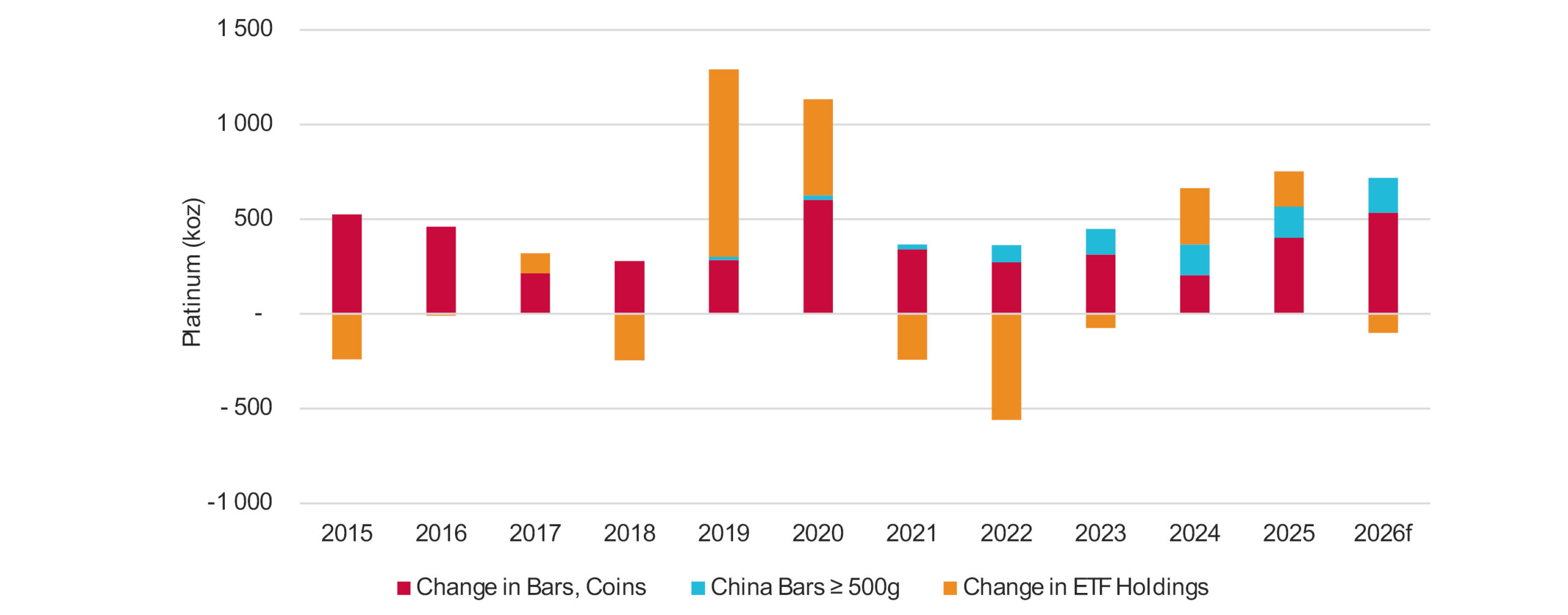
As illustrated in Chart 6, investment demand has become an increasingly important source of support for the platinum market. While ETF flows have historically been volatile, recent years have seen a meaningful increase in physical investment demand, particularly from Chinese investors through bars and larger-format investment products. This has broadened the investment demand base beyond traditional Western ETF investors and helped offset periods of ETF outflows.
Chart 6: Annual change in ETF holdings, coins and China bars demand
Source: World Platinum Council (Q1 2026)
The emergence of a more diversified investment bid is an important development for the platinum market. While investment flows can amplify short-term price volatility, they also provide an additional source of demand alongside automotive and industrial consumption. In an environment characterised by geopolitical uncertainty, elevated sovereign debt levels and persistent concerns around inflation, investment demand is likely to remain an increasingly important component of the platinum demand profile.
Ultimately, It Is About Supply
While PGM demand remains cyclical and influenced by vehicle production, emissions standards and the pace of electrification, we believe the investment case is ultimately determined by supply.
South Africa and Russia account for the vast majority of global PGM production. Following several years of depressed prices, large parts of the industry are struggling to earn acceptable returns, resulting in shaft closures, production curtailments and sharply reduced capital investment. Unlike many commodity markets, PGM supply cannot respond quickly to higher prices. Production is concentrated in deep, capital-intensive and geologically complex ore bodies, making supply highly inelastic.
Ultimately, the case for PGMs remains a supply story. Commodity markets do not require strong demand growth to generate attractive returns, only that supply fails to keep pace with demand. Based on our forecasts, total PGM demand is likely to grow faster than supply over the next five years, supported by resilient automotive demand, growing investment demand for platinum and continued industrial consumption. Against a backdrop of years of underinvestment, production curtailments and limited new project development, the supply base remains constrained and increasingly inelastic. This imbalance is expected to result in widening market deficits, providing a supportive backdrop for PGM prices and reinforcing our view that the market continues to underestimate the strength of the PGM investment case.