
It was October of 2022, and the Northstar Investment Team had endured months of grilling from institutional investors visiting our offices or on Teams meetings, all obsessing over Northstar’s purchase of gold across all our portfolios.
We started buying gold in December 2021 at a price of $1800 per ounce, holding about 5% in our medium risk/medium growth funds, by mid-October 2022 the desired allocation of 10% was reached, but the price had fallen to $1650 per ounce. We were out of the money, albeit by a smidgen. The harshest criticism was directed at the gold exposure held within the Northstar BCI Income Fund. We got the message loud and clear, ‘No rational manager would buy gold.’
Reasons given at the time included: gold has no yield, gold is extremely volatile and gold has no value. Of course, the actual reason is steeped in behavioural finance, gold had performed so poorly for so long that these professional investors could not visualize a path out of this malaise.
Let us fast forward to March 2026, Northstar continues to hold gold exposure in certain of our funds (particularly the domestic fund range), but by and large, we have sold most of the gold we held. And we realized nowhere near the prices that the metal trades at today, our exit price was closer to $3200 per ounce, having sold in May 2025.
These days, we face those same people in those same meetings, just as we did in 2021, but the criticism seems to have inverted, the current questioning is around why we do not own enough gold, why we would take such extreme risks, why we cannot see the obvious! ‘No rational manager would sell gold!’
So why did Northstar buy gold in 2021 in the face of rebuke and why did we sell it last year, when ‘no rational manager would’?
Our investment infrastructure or process highlighted gold in 2021 as being under appreciated, we cannot claim undervalued, as we do not believe that gold can be valued. But through our formulaic approach, which is not tick-box, but all boxes must be ticked, gold seemed worth owning. That same infrastructure drove our decision to reduce gold in 2025.
But before we get into those details, it is worth making some critical points.
- We cannot predict the future price of gold. Nobody can.
- The labyrinth of factors that are in perpetual motion economically, geopolitically and sociologically make most predictions cow manure. In fact, studies analysing thousands of public forecasts from experts between 2005 and 2012 found that, on average, their accuracy was under 47%, which is worse than a coin flip. (Good Judgement Project)
- The work done by Philip Tetlock on superforecasters shows clearly that smart forecasters work in probabilities rather than pin-point accurate predictions.
- The best stock pickers in the world only get 6 out of 10 decisions right.
Knowing this helps ensure cynicism that curtails large risky and overconfident bet sizes. In our gold deliberations, we sought to understand and test all the common models that are used to predict gold prices. Our findings were as follows.
- A higher gold price is usually associated with lower TIPS (Treasury Inflation Protected Securities) yields over the medium term but is not accurately predictive.
- The forward price of gold (commodities have forward price markets) is unreliable for determining the spot market price in the future.
- The commonly used methods of comparing the gold price to other commodities such as silver, oil and copper and using this ratio to project forward gold prices is tenuous.
- A weaker US dollar is associated with higher gold prices more often than a stronger dollar, but this relationship is weak and inconsistent.
- We believe that certain central banks will remain important gold buyers in the years ahead, however, the narrative that they will be the ultimate determinant of the gold price due to de-dollarization, we take with a pinch of salt. 220 000 tonnes of gold exists above ground; central banks own 16% of this. Jewellery represents 52% of above market stocks. But importantly, collectively, financial institutions and individual investors own almost 30% of global stockpiles – a significant portion of this is for speculation. Central banks are buying about 1 000 tonnes a year, so 20% of new supply, yet ETFs (speculators) bought as much gold as central banks in 2025. With new gold supply at only 5 000 tonnes per year, adding a mere 2% annual additional supply, this is a market prone to extreme price moves – up and down. Reduce demand from price sensitive jewellery buyers and the gold market cavitates (50% of new annual supply is purchased for jewellery) as was the case from 2013 to 2019. This is equally true for the gold price when gold ‘investors’ destock.
The Gold Story:
I mentioned above that we do not believe that gold can be valued, this is key to us, as we follow a deliberate valuation-based framework across every security or asset class that we buy, hold or sell at Northstar. We acknowledge that valuation was not our main driver for investing and disinvesting from gold.
But we did apply, what we consider a very rational framework to make our decision to buy and then to sell. The two key factors being our gold ‘model’ that provides us with an indicative view of what the precious metal might trade at, if investors think a specific way. Then, a portfolio construction reason, I will deal with that hereafter.
Let’s start with our gold ‘model’ which relies on the assumption (and we appreciate that this is a brave assumption) that investors, during periods of heightened uncertainty, view gold as a substitute or alternative to the dollar. This has of late, played out precisely as we expected.
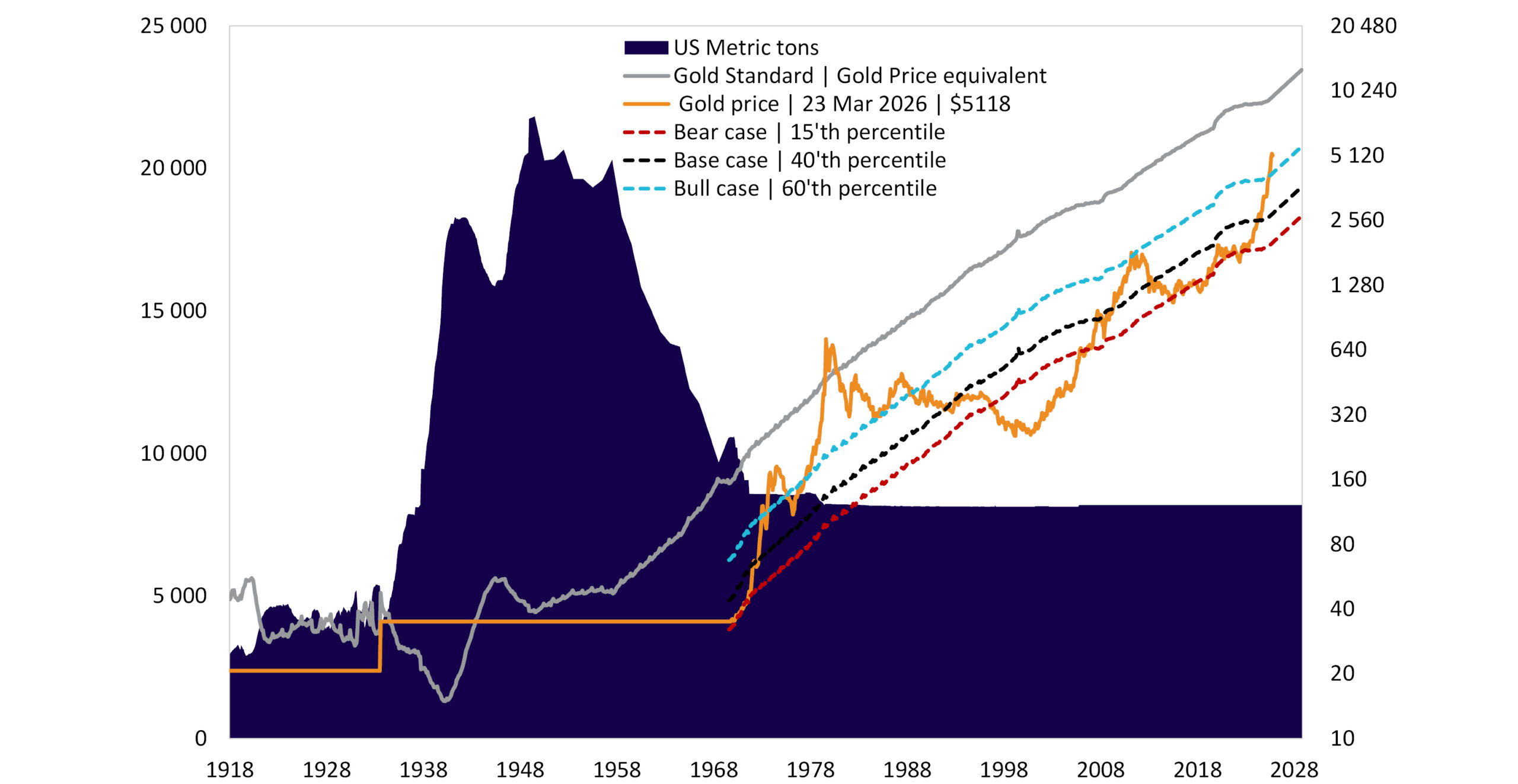
Chart 1 illustrates our thinking.
The blue shaded area are gold reserves held by the USA going back to 1918 in tons. As can be seen, these reserves rose to over 20 000 tons in the mid 1950’s and in the mid 1970’s decreased to about 8100 tonnes, which is what they continue to hold today.
The orange line is the gold price over time.
In 1944, the world entered the Bretton Woods System, which pegged major currencies to the US dollar and the dollar was anchored or underpinned to a gold price of $35 per ounce. The US promised to convert dollars into gold should this be required for foreign governments. The idea behind the system was to stabilize global currencies with the dollar becoming the primary global reserve currency.
Problems started to arise in the mid 1960’s due to excessive US expenditure on the Vietnam war which undermined the dollar. In 1971 Nixon ended the Bretton Woods system, effectively cancelling the promise that the US would guarantee dollars with gold. Through this entire period, the supply of US money in circulation rose.
Considering under Bretton Woods, all currency in circulation was backed by the value of the gold held by the USA, we can use that as a starting or reference point. The grey line in the chart shows what the gold price needed and needs to be at, over time, for the gold reserves held by the USA, let’s say 8 100 tonnes to be equal in dollar value to the cash in circulation in the US economy. So, currently, the US has about $2.5 trn of currency in their financial system, if gold had to cover that in value, the gold price would need to be $9500 per ounce.
It should be clear from the chart that the gold price is very volatile, but has only once, in 1980, reached a price where gold reserves surpassed the value of US dollars in circulation. Consequently, accounting for that, we created gold trading ranges, with bear, base and bull outcomes. When we bought our gold exposure at $1800oz, based on this work, gold was trading at our bear case, when we sold it, at prices around $3500 per ounce, it had exceeded our base case valuation. At $5400, the price level at the time of writing this article, gold has exceeded our bull case.
Chart 1: Gold Valuation: Caution (Gold price vs Gold Standard Equivalent Price)
Source: FRED, Federal Reserve Bank of St. Louise, Iress & Northstar
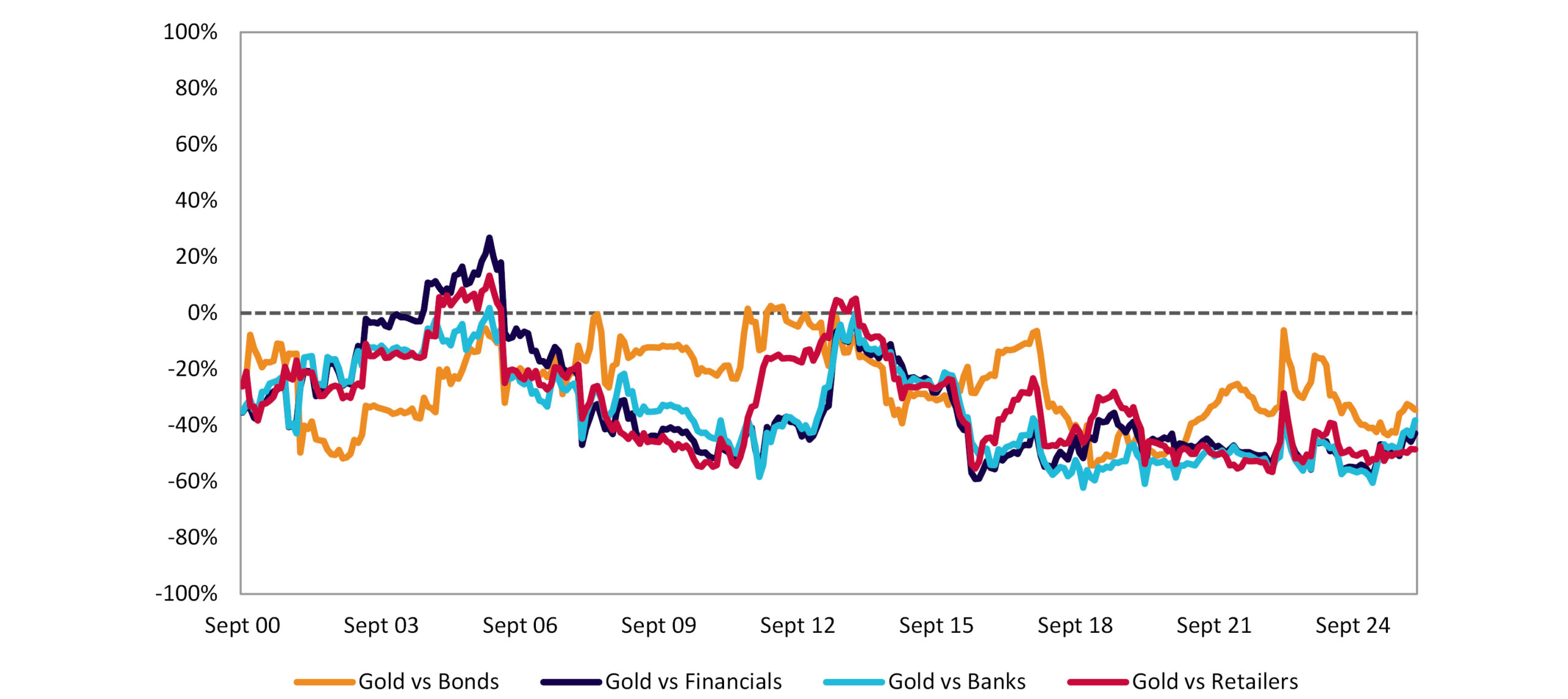
The second main reason why we felt that gold held appeal for us, is diversification. But, more importantly, gold has quite a unique characteristic in portfolios, if often behaves very differently to the other asset classes we can own for clients, it effectively, dampens risk.
In Chart 2, we show in line charts, gold versus other sectors that we can buy into for our clients on the JSE. Note that this is a correlation chart and the correlations are negative, implying that gold tends to move opposite to the other sectors.
Chart 2: Correlation: Gold vs Bonds, Financials, Banks and Retailers
Source: FRED, Federal Reserve Bank of St. Louise, Iress & Northstar
If time and space allowed for it, I could wax lyrical on our gold research, with particular emphasis on its price characteristics, its use cases in portfolio construction and critically, how damaging it can be to client wealth, if mismanaged.
But the key message in this article is that our approach to investing is not about guessing, we have no futuristic abilities, in fact, considering the price is at $5400 today, based purely on this, we have been wrong selling out of gold. But that’s really the point, nobody knows what the price of gold will be tomorrow, next week, a year from now or even a decade from today. If you were forced to choose, indicating whether you believed the price would be higher or lower in the future, being right or wrong, is purely good or bad luck, and that’s all it is – LUCK!
But there are times when good data can, and I am not saying will, push the odds in your favour. We always aim to build smart decision making frameworks using probabilistic thinking, to position our clients favourably for future outcomes.