
South African investors are all too familiar with Tencent through years of volatility in Naspers and Prosus. Chinese policy headwinds, consumer weakness, and now concerns over AI disruption and investments have weighed on Tencent’s share price. Assessing the current opportunity requires understanding whether China remains investable, where the returns from its AI ambitions may accrue, and how Tencent is positioned. At around 12 times forward earnings, the long-term opportunity is underappreciated.
Is China investable?
While our investment process is grounded in bottom-up analysis, China carries risks beyond the fortunes of individual businesses. Unpredictable policy intervention and geopolitical tensions have led some investors to regard it as uninvestable, while property sector weakness and subdued consumer demand add to the challenges.
However, China’s Marxist-Leninist foundations do not imply an outright rejection of private enterprise. Under Deng Xiaoping, China embraced private enterprise and foreign investment as tools for economic development. These reforms reflected the view that China’s ‘primary stage of socialism’ required greater productive capacity to achieve its long-term goals.
Under Xi Jinping, the balance has shifted towards stronger Party control and national security, but private enterprise continues to serve its economic ambitions through innovation, employment, and growth. The Private Sector Promotion Law, adopted in April 2025, reinforces this through provisions supporting fair competition and business rights. While commercial interests remain subordinate to political priorities, China’s ongoing need for private-sector development and access to international markets, technology, and investment creates an incentive to uphold these protections.
In our view, China remains selectively investable while private-sector contributions remain important to the leadership’s development goals. Even with periodic policy setbacks, this alignment gives businesses sufficient runway to invest, earn sustainable profits, and return them to shareholders. Our focus remains on durable competitive advantages, sustainable cash generation, and valuations that adequately compensate for the risks.
AI in China: where will the returns accrue?
China’s AI Plus policy supports investment in infrastructure, models, and applications to improve productivity across the economy. Affordable, widely available AI serves this goal, but the benefits may accrue to its users rather than the companies funding its development.
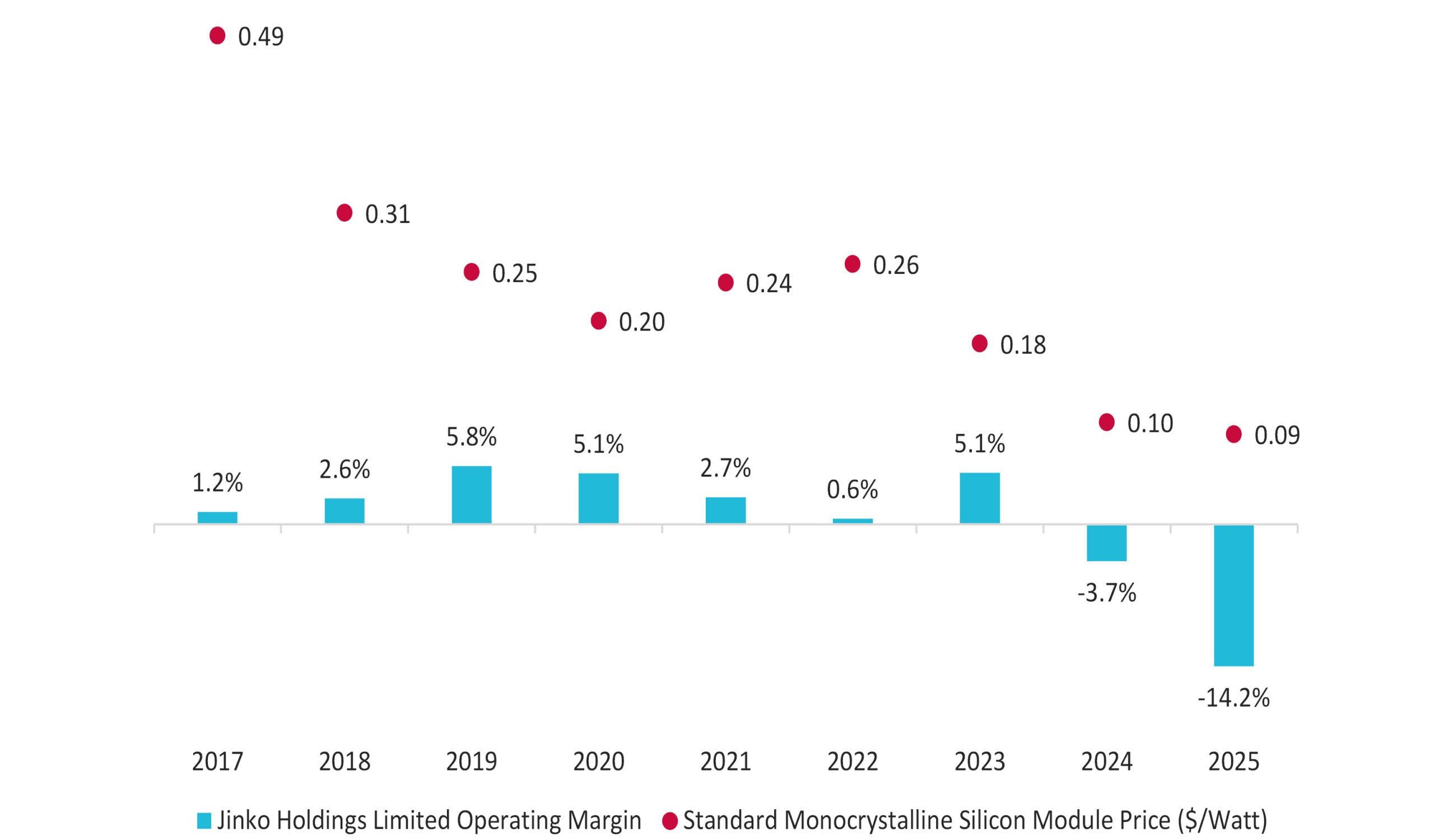
Solar provides a useful comparison. Subsidies and favourable financing helped China build a globally dominant industry, but also encouraged excess capacity that undermined pricing and profitability. As Chart 1 shows, even a market leader such as JinkoSolar struggled to protect margins as module prices fell, with rising input costs adding further pressure in 2025. The industry delivered cheaper energy, but poor returns for shareholders – a reminder that strong demand and scale offer limited protection when products are interchangeable and supply outpaces demand.
Chart 1: Overcapacity in solar weakened pricing and profitability
Source: Bloomberg, S&P Capital IQ
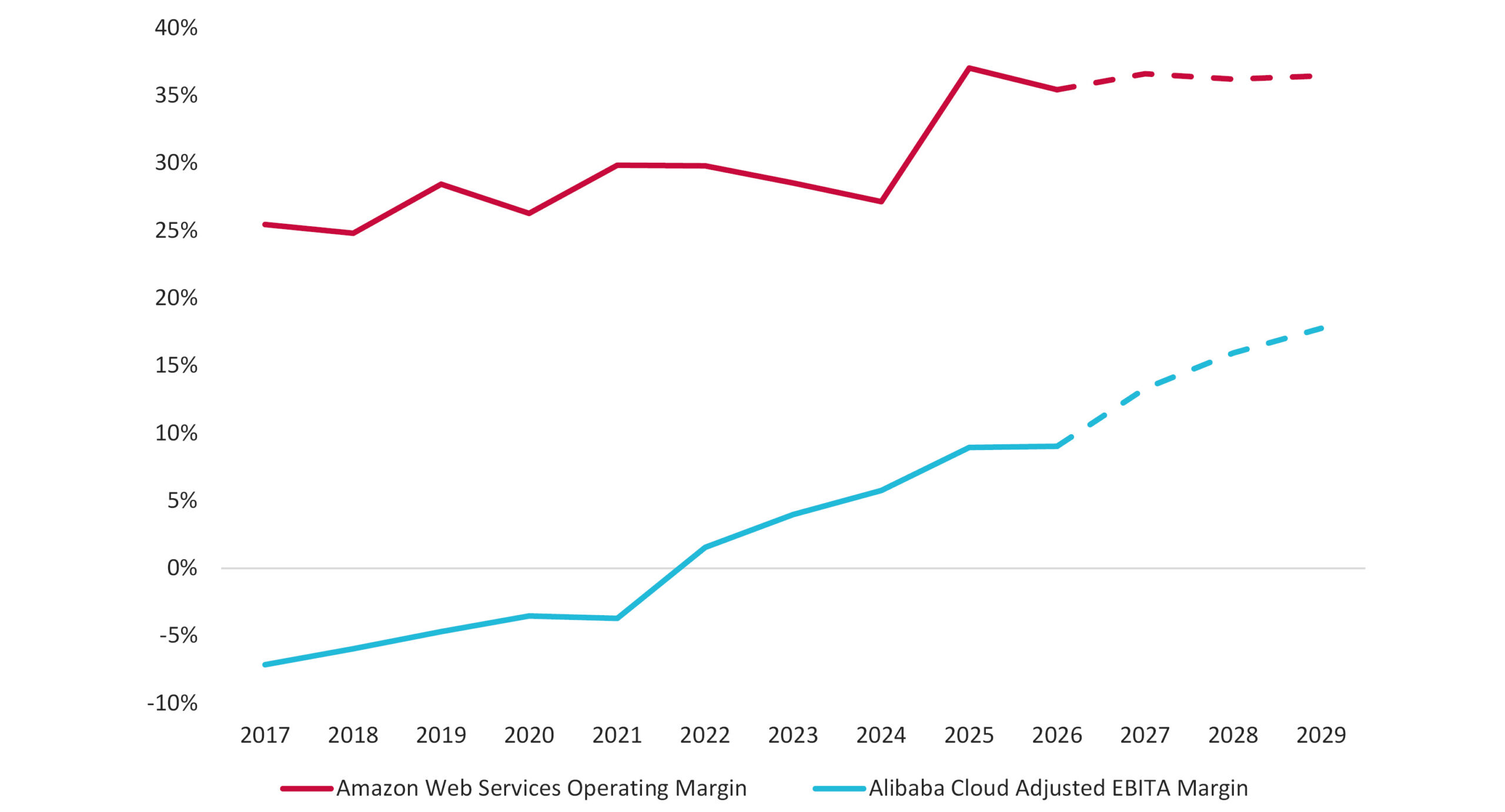
The implications for AI in China depend on where a business competes. Cloud computing providers are investing heavily to meet demand. Scale and higher utilisation can improve margins, while additional software and database services can strengthen switching costs and pricing power. Nevertheless, Chinese providers such as Alibaba are likely to remain less profitable than US peers as they prioritise growth, with Chart 2 illustrating the gap to AWS. Basic computing capacity remains difficult to differentiate, leaving margins vulnerable as supply expands. As in solar, if supply outpaces demand, competition could drive prices lower and erode returns.
Chart 2: Alibaba’s cloud margins are improving, but remain below AWS’s
Source: Bloomberg, S&P Capital IQ, Company Reports
Model developers in China face similar challenges. Z.ai, for example, remains heavily loss-making as it invests in development and adoption, in the hope that scale will eventually deliver sustainable profits. The investment burden extends to larger platforms, with consensus forecasts implying over US$30 billion in cumulative adjusted EBITA losses for Alibaba’s AI Labs and Applications division over the next five years.
Intense competition and China’s support for open models make returns on these investments uncertain, particularly for the smaller labs. Other providers can host publicly released models and charge for access without bearing the original development costs, creating scope to compete on price. In addition, as models become sufficiently capable for everyday tasks, customers have less reason to pay a premium for more advanced alternatives. As in solar, growing adoption may benefit customers without generating adequate returns for the companies funding development.
The question, then, is who is best placed to turn wider AI adoption into sustainable profits. In our view, established platforms offer a more attractive route to returns. Falling model costs can help improve services at a lower cost, while existing users, distribution, and commercial relationships provide ways to earn more from greater engagement, more effective advertising, and increased transactions. Tencent’s extensive network positions it well to capture this opportunity.
Tencent: extending the network
Alongside its global gaming leadership, Tencent’s investment case has long rested on its ability to deepen engagement and broaden monetisation across its entrenched network of users and businesses within Weixin – its all-in-one communication, content, and payments platform. Management’s early emphasis on using AI to improve these businesses is already paying off. Within Weixin, better recommendations and advertising targeting are improving engagement and advertiser returns. In gaming, AI is accelerating content production, improving efficiency, and enhancing virtual characters and gameplay. These improvements reinforce the original investment case by generating more value from Tencent’s established platform and franchises.
With this early success and improving model capabilities, management’s ambitions have broadened. Tencent is now investing aggressively in computing capacity, models, and new products. This is partly defensive, as competing AI assistants aim to shift users’ time and spending away from Weixin. However, Weixin’s Mini Programs, merchant relationships, and payment infrastructure give Tencent a strong foundation for developing superior assistants.
Early signs are encouraging. WorkBuddy, its workplace assistant, is gaining traction, while Xiaowei is being tested within Weixin to help users find content, discover products, and complete transactions. Tencent is developing its own models around these applications, leveraging proprietary data to guide training, improve capabilities, and reduce costs. Returns must still be proven, but Tencent’s ability to develop and distribute AI across an established network gives it a credible opportunity to strengthen its core businesses and create new sources of income.
Valuation: pricing in permanent headwinds
The current investment cycle is weighing on near-term earnings and cash flow. In the second quarter of 2026, non-IFRS operating profit grew 9% year-on-year, compared to 19% excluding New AI Products, highlighting the underlying strength of the core business. Positively, strong cash generation from established businesses and a substantial investment portfolio help Tencent fund the buildout while sustaining buybacks and limiting the need to dilute shareholders.
At around 12 times forward earnings, investors are paying a low multiple on an earnings base already depressed by investment spending. Adjusting for the investment portfolio and its associated earnings reduces the multiple to roughly 10 times. While investment returns remain uncertain, the valuation reflects considerable scepticism around China, AI investments, and disruption, while underappreciating the durability of Tencent’s core business and the potential for current investments to strengthen it.